Monday, February 17, 2014

The Iroquois (IX): The Tuscarora People

Location:   Upstate New York
Year:   1720

The Tuscarora ("The People Who Gather Hemp" or "The People of The Shirt") are an Iroquoian-speaking people who, sometime before the establishment of the Haudenosaunee Confederacy, moved south to eastern North Carolina where they settled along the Tar, Neuse, Roanoke and Pamlico rivers.

A powerful people, they were, nonetheless, devastated by epidemics and decimated in wars after the arrival of European colonists. In 1720, they moved north, back to New York, where they were accepted into the Haudenosaunee League as the Sixth Nation, and given lands by the Oneida and the Onondaga. During the Revolutionary War, they, like the Oneida, sided with the Patriots. 

After the war, the tribe was divided: Some settled on their own Reservations, others shared land with the Oneida, many moved to Canada, and some returned to North Carolina, rejoinng the remnant that had remained behind, and a small group emigrated to the Indian Territory (Oklahoma). During the War of 1812, the Tuscarora again sided with the United States; during a British attack on Lewiston, New York, American forces fled the field, leaving the Tuscarora (outnumbered 30-to-1) to hold the town. The Tuscarora were slaughtered, and only a handful escaped. 

Today, the Tuscarora as a People are badly disunified. As tribal entities, the Tuscarora Nation in New York refuses to recognize the Tuscarora Nation in North Carolina and Oklahoma, while the North Carolinian Tuscarora claim to be the ancestral band.  Individuals however, work to maintain the shared heritage of all Tuscarora.


The Iroquois (VIII): The Seneca People

Location:   Western New York State
Year:   13th Century (?)

Ah-Weh-Eyu, "Pretty Flower" a Seneca woman, 1908

The Seneca People were (and still are) the largest of the Iroquois Six Nations. Originally occupying an area between the Genessee River and the Great Lakes, they were divided into two groups even within the organization of the Haudenosaunee Confederacy. The West Seneca lived along the Genessee (eventually moving west toward Lake Erie) and the East Seneca lived around Seneca Lake (eventually reaching south to the banks of the Allegheny River). 

Living in highly-ordered walled villages, the Seneca were devoted agriculturalists and hunters. Called "The Keepers of The Western Door" by the other Haudenosaunee, they called themselves Onondaghwya, "The People of The Great Hill." However, to avoid confusion with their brethren in the Onondaga Tribe, they assumed the name "Seneca," meaning "People of The Place of Stones." The similarity of their name with the Roman philosopher Seneca is coincidental.   

Internally, the Seneca maintained a representative democracy in which the political process was overseen by women. This system is still in existence, a system of representative democracy which predated, influenced and is similar to the political system of the United States. 


Fierce warriors, they were the traditional leaders of all Hudenosaunee war parties. They most often also acted as the Iroquois' favored diplomats with other tribes and with whites.

Red Jacket (1750-1830) was a famous Seneca orator of the Wolf Clan,  famed for such quotes as, "Most powerful is he who has himself in his own power," "The sun also shines on the wicked," and "It is another's fault if he be ungrateful; but it is mine if I do not give." A speaker of all the Iroquois languages, French and English, he acted as the Iroquois' Senior Ambassador in most dealings with Euro-Americans. He addressed the U.S. Senate in 1805.

 Red Jacket got his English name when a British officer gifted him with a uniform coat during the Revolutionary War. The Iroquois however called him Sagoyewatha meaning "He who keeps them awake."  

Seneca bands still live in New York State on several Reservations and among the general population as well. The Seneca own the upstate city of Salamanca.  They have used their remaining power and influence to diversify their holdings, including casinos, real estate, cigarette sales, resorts, broadcasting, and industry. A significant number of Seneca belong to the professions. 

Other Seneca groups live in Missouri and Ohio and Canada. Although it is difficult to estimate the total population of the Seneca People, it exceeds 50,000 in total. 

Sagoyewatha, "He Who Keeps Them Awake" or Red Jacket

Red Jacket's Address To The U.S. Senate, 1805

Friend and brother:

It was the will of the Great Spirit that we should meet together this day. He orders all things, and he has given us a fine day for our council. He has taken his garment from before the sun, and caused it to shine with brightness upon us; our eyes are opened, that we see clearly; our ears are unstopped, that we have been able to hear distinctly the words that you have spoken; for all these favors we thank the Great Spirit, and him only.

Brother, this council fire was kindled by you; it was at your request that we came together at this time; we have listened with attention to what you have said. You requested us to speak our minds freely; this gives us great joy, for we now consider that we stand upright before you, and can speak what we think; all have heard your voice, and all speak to you as one man; our minds are agreed.

Brother, you say you want an answer to your talk before you leave this place. It is right you should have one, as you are a great distance from home, and we do not wish to detain you; but we will first look back a little, and tell you what our fathers have told us, and what we have heard from the white people. 

Brother, listen to what we say. There was a time when our forefathers owned this great island. Their seats extended from the rising to the setting sun. The Great Spirit had made it for the use of Indians. He had created the buffalo, the deer, and other animals for food. He made the bear and the beaver, and their skins served us for clothing. He had scattered them over the country, and taught us how to take them. He had caused the earth to produce corn for bread. All this he had done for his red children because he loved them. If we had any disputes about hunting grounds, they were generally settled without the shedding of much blood. But an evil day came upon us; your forefathers crossed the great waters, and landed on this island. Their numbers were small; they found friends, and not enemies; they told us they had fled from their own country for fear of wicked men, and come here to enjoy their religion. They asked for a small seat; we took pity on them, granted their request, and they sat down amongst us; we gave them corn and meat; they gave us poison in return. The white people had now found our country; tidings were carried back, and more came amongst us; yet we did not fear them, we took them to be friends; they called us brothers; we believed them, and gave them a larger seat. At length, their numbers had greatly increased; they wanted more land; they wanted our country. Our eyes were opened, and our minds became uneasy. Wars took place; Indians were hired to fight against Indians, and many of our people were destroyed. They also brought strong liquor among us; it was strong and powerful, and has slain thousands.

Brother, our seats were once large, and yours were very small; you have now become a great people, and we have scarcely a place left to spread our blankets; you have got our country, but are not satisfied; you want to force your religion upon us.

Brother, continue to listen. You say you are sent to instruct us how to worship the Great Spirit agreeably to his mind, and if we do not take hold of the religion which you white people teach, we shall be unhappy hereafter. You say that you are right, and we are lost; how do we know this to be true? We understand that your religion is written in a book; if it was intended for us as well as you, why has not the Great Spirit given it to us, and not only to us, but why did he not give to our forefathers the knowledge of that book, with the means of understanding it rightly? We only know what you tell us about it. How shall we know when to believe, being so often deceived by the white people?

Brother, you say there is but one way to worship and serve the Great Spirit; if there is but one religion, why do you white people differ so much about it? Why not all agree, as you can all read the book?

Brother, we do not understand these things. We are told that your religion was given to your forefathers, and has been handed down from father to son. We also have a religion which was given to our forefathers, and has been handed down to us their children. We worship that way. It teacheth us to be thankful for all the favors we receive; to love each other, and to be united. We never quarrel about religion.

Brother, the Great Spirit has made us all; but he has made a great difference between his white and red children; he has given us a different complexion, and different customs; to you he has given the arts; to these he has not opened our eyes; we know these things to be true. Since he has made so great a difference between us in other things, why may we not conclude that he has given us a different religion according to our understanding. The Great Spirit does right; he knows what is best for his children; we are satisfied.

Brother, we do not wish to destroy your religion, or take it from you; we only want to enjoy our own.

Brother, you say you have not come to get our land or our money, but to enlighten our minds. I will now tell you that I have been at your meetings, and saw you collecting money from the meeting. I cannot tell what this money was intended for, but suppose it was for your minister; and if we should conform to your way of thinking, perhaps you may want some from us.

Brother, we are told that you have been preaching to the white people in this place. These people are our neighbors; we are acquainted with them; we will wait, a little while and see what effect your preaching has upon them. If we find it does them good, makes them honest and less disposed to cheat Indians, we will then consider again what you have said.

Brother, you have now heard our answer to your talk, and this is all we have to say at present. As we are going to part, we will come and take you by the hand, and hope the Great Spirit will protect you on your journey, and return you safe to your friends.

Saturday, February 15, 2014

The Iroquois (VII): The French and Iroquois War (1650-1700)

Location:   The Midwest
Year:   1650-1700

Iroquois warriors attacking a French trading post

The French and Iroquois War of 1650-1700 (not to be confused with The French and Indian War of 1754-1763), sometimes called the Beaver Wars or just the Iroquois Wars, was an expansionist military campaign waged by the Haudenosaunee Confederacy over the latter half of the 17th Century in order to establish unified control over the rich lands of the American Midwest. 

Although the French and Iroquois War has been largely forgotten by Euro-American historians, it was the largest and bloodiest war to occur in North America until the U.S. Civil War of 1861-1865. Casualties are impossible to determine with any accuracy, but they may have been as high as a half-million.

The war began due to the confluence of the Haudenosaunee's long-time desire to subjugate neighboring enemy tribes with the preference of the British and Dutch colonial powers to have dealings with a unified, organized and centralized Indian entity---the Haudenosaunee.

The war also served the purpose of discommoding the French, who had laid claim to a vast area in the North American heartland, an area neither the British, the Dutch, nor the Iroquois wished them to control. 

In the opening gambit of what became the Beaver Wars, the Seneca moved against the Wenro, a people who lived west of the Genessee River and east of Lake Erie. Although an Iroquian-speaking tribe closely related to the Seneca, the Wenro were traditional enemies of the Iroquois League. 

In a brutal campaign lasting several years, the Seneca burned all of the Wenro villages and denuded their food stocks. Most of the Wenro fighting men were killed. The children and women of child-bearing age were forcibly adopted into the Iroquois tribes, and the remaining men enslaved. The few surviving Wenro fled west to seek asylum with the Erie and the Huron, where they quickly became assimilated. The Seneca occupied the Wenros' territory, and, in effect, the Wenro ceased to exist as a people.

Parenthetically, although slavery existed among the Iroquois, it was not widely practiced. Captives were, for all intents and purposes, slaves. However, the Iroquois' policy of adopting captives into the tribes included giving them full rights under Gayanashagowa.

During the campaign against the Wenro, the Mohawks likewise moved against the Pequots and Mohicans living in present-day Vermont, defeated them, and extended the boundaries of the Iroquois Confederacy to the Connecticut River. They then spread north, crossing the St. Lawrence River, and subjugated the Abenaki, Penobscot, Ottawa and the Ontario Peoples, taking control of much of current-day lower Quebec. 

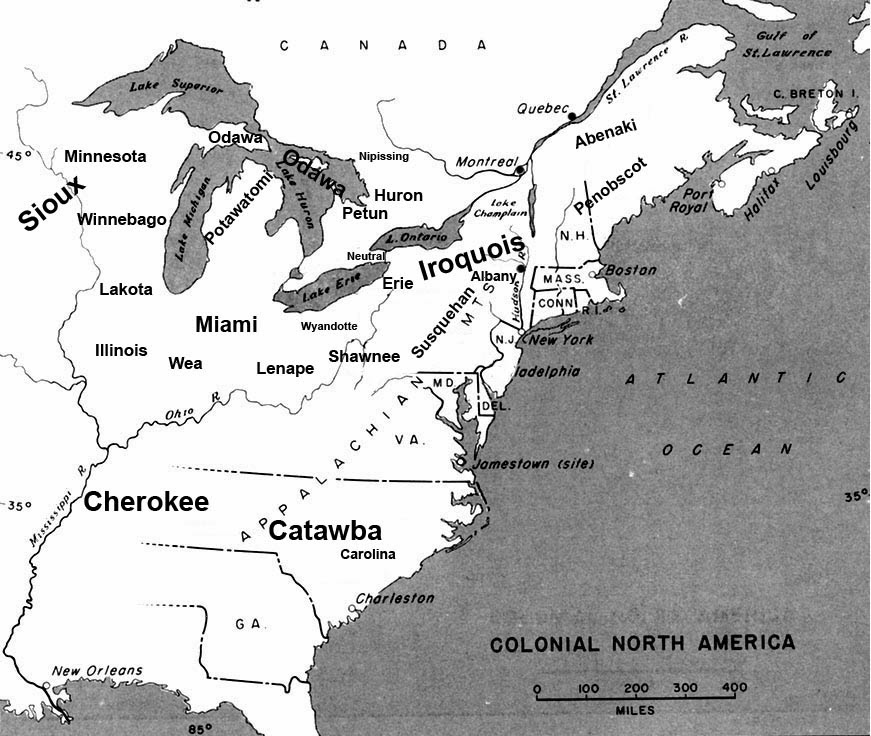
The tribes listed on this map were subjects of the Iroquois Empire
Although they did not harass the British and Dutch settlers in New York during the French and Iroquois War, the Iroquois extended their zone of influence south of the Catskills and all the way to Long Island, forcing the local Algonkian tribes to acknowledge their suzerainty. The Island was given the name, "Paumanok," meaning "Land of Tribute." The Iroquois then seized effective control of Pennsylvania, Maryland, Virginia, and into northern North Carolina.

The Confederacy moved against the Hurons and the Eries, and a confederation of tribes called the Neutrals, passing into modern-day Ontario and Ohio. They aggressively moved south and west. 

By 1700, the Iroquois controlled a vast area centered on the Great Lakes stretching from Lake Nipigon in the north to the latitude of Nashville, Tennessee in the south, and reaching from the Mississippi River to beyond the Connecticut River to the Atlantic. 

American schoolchildren are frequently taught that "New France" was only lightly colonized by missionaries and trappers; the French and Iroquois War is the reason. Unable to assert any real control over the American heartland, the French chose not to trouble themselves with their colonial holdings for a long period. It is little remembered, but the Iroquois managed to drive the French out of the Middle West completely for extended periods of time. 

Many First Nations fled the Iroquois Empire. The mighty Sioux Nation, until then, a woodland folk of Wisconsin and Minnesota, moved west onto the treeless plains of Minnesota in what became the first stage of their transmutation into the quintessential bison-hunting tribe of the Great Plains. 

Unfortunately for the Iroquois (and one might say unfortunately for the subsequent course of Native American history in North America), the Haudenosaunee leadership dealt unwisely with their subject peoples. Smaller, weaker tribes went the way of the Wenro; and larger and more powerful tribes, like the Miami, the  Pottawatomie, the Cherokee, the  Catawba, the Ojibwa, and the Shawnee, were expected to rendering humiliating tribute, being forced to provide their conquerors with foodstuffs, weapons, wampum, such money as they had, goods of all types, slaves, women and children for forcible adoption into the Iroquois tribes, and furs, particularly beaver pelts. This caused widespread poverty and starvation among the Native Americans.

Due to their policy of forcible adoption, the Iroquois people became a melting pot of Native American Nations, absorbing new ideas, customs, and styles (the haircut popularly called a "Mohawk" was in its origins, a Shawnee warrior hairstyle). The Susquehanna People of Pennsylvania were adopted into the Iroquois tribes en masse.  

However, not one of the subject tribes was asked to join the League.  This is in sharp contrast to the later decision of the Haudenosaunee to invite the displaced Tuscarora People to move into the metaphorical longhouse. 

The brutality and destructiveness of the war, combined with the terrible policy of tribal subjugation followed by the Iroquois resulted in the rapid loss of their hard-won empire. When the French re-entered the Iroquois realm seeking to retake the land by force, they found thousands of willing indigenous allies to fight against the Haudenosaunee. By 1701, the Iroquois were forced to surrender Minnesota, Wisconsin, Michigan, Illinois, Indiana, Ohio, and Ontario; and the rest of their empire was stripped way from them by stages in hundreds of forgotten confrontations, by treaty, and during the French and Indian War and the American Revolution, particularly.  

Worthy of consideration is the thought that had the Iroquois leadership of the 17th Century been more foresightful, they might have asked the subject peoples of their short-lived empire to join the League as equals in alliance against the strangers from across the sea. Had they done so, the colonizing Europeans would have faced a unified and determined native population, perhaps stretching across the continent and not so easily overcome. It is quite likely in that event, that the course of American history and the fate of the First Nations, would have been far, far different than it has turned out to be.   


The burning of a Huron village


Friday, February 14, 2014

The Iroquois (VI): The Cayuga People

Location:   The Finger Lakes Region
Year:   13th Century (?)


The Cayuga People, known as "The People of The Great Swamp" or "The People Who Carry Canoes" historically occupied the Finger Lakes region of New York. The Cayuga lived between the Onondaga and the Seneca. They fished in Lake Ontario and in the numerous lakes in their region, were hunters of game, and cultivated maize. They were known for their beadwork and their creation of sacred masks.


During the Revolutionary War, the Cayuga were split. Most fought alongside the British, while a few fought alongside the American Patriots. As the Colonists gained the upper hand, George Washington ordered a punitive expedition against the pro-British Cayugas. Many Cayugas were slaughtered, and this caused the pro-American Cayugas to switch sides. Cayuga losses in the American Revolution were the highest per capita of any Iroquois tribe. 

Although the Cayuga were granted lands in the Treaty of Canandaigua in 1794, local Euro-Americans disregarded the Treaty and took over the Cayuga lands. 

The Cayuga today are a scattered people, with bands in Canada, Ohio, Oklahoma, and New York. They do not even have a tribal Reservation in New York State. Instead, they live among the other Haudenosaunee on their Reservations. The Cayuga language is nearly extinct, and the Nation has less than 5,000 members overall.   

The Iroquois (V): The Onondaga People

Location:   Upstate New York
Year:   13th Century (?)


Under the shade of this Tree of Peace . . . there shall you sit and watch the Fire of the League of Five Nations. Roots have spread out from the Tree of Great Peace . . . These are the Great White Roots, and their nature is Peace and Strength. If any man or any nation shall obey the Laws of Peace . . . they may trace back the roots of the Tree . . . They shall be welcomed to take shelter beneath the Great Evergreen Tree ---Deganawida The Great Peacemaker.

The Onondaga People, "The People of The Hills," lived within a relatively narrow but long strip of land running from Lake Ontario in the north to the Susquehanna River in the south.  Modern cities that lie in their territory include Oswego, Syracuse, and Binghamton.

Of the original Five Nations, the Onondaga occupied a central place, both geographically and culturally. Deganawida The Great Peacemaker of the Iroquois, was an Onondaga. Tradition holds that when Deganawida and Hiawatha succeeded in bringing forty-nine Chiefs of the Five Nations together, they met at Onondaga, the main town of the Onondaga People, on the shores of Lake Onondaga. This place became the site of the Great Council Fire, the capital city of the Iroquois Confederacy. While the Confederation lasted in its homeland, the Council Fire was never permitted to go out. 

A European addresses a group of Iroquois Chiefs at a Council Fire

It is said that the Chiefs agreed to uproot a tall standing white pine at the site and bury all their war weapons beneath it. This was done, and the white pine was replanted, becoming the Tree of Peace. Culturally, the Tree of Peace was the axis of the Lower Realm just as the Tree of Life was the axis of the Iroquois Upper Realm, and the Onondagas were its keepers.


According to Iroquois historians, Hiawatha commemorated the event by creating a mosiac representation of the joining of the Five Nations. This was the first wampum belt. Although Euro-Americans think of wampum as money, wampum was a complex system of communication in which every material, color and position of a symbol held a very specific meaning.  


Tradition says that as this was being done, a renegade Chief named Tadadaho appeared among the group. Warped with evil, he, medusa-like, had serpents for hair. Although he first refused to make peace, Deganawida, Hiawatha, and the other 49 Chiefs eventually convinced him. The women of the gathering combed the snakes out of his hair, and he buried his weapons, becoming the fiftieth Iroquois Chief, and the one most prone to peace. To this day, the 50th Chief is still accorded the special title of Tadadaho, and is tasked with being the conciliator of the Great Council.  


Traditionally, the Clan Mothers elected the Tribal Chiefs. The Onondaga still keep this tradition. 

The position of the Onondaga at the geographical center of the Confederation combined with their central position in keeping the Great Council Fire and the Tree of Peace to make them particularly resistant to the blandishments of missionaries and Euro-American traders, and so they maintained the old traditions for a long time in the face of mounting pressures both from whites and other Iroquois. 

In 1720, they ceded part of their traditional homeland to the Tuscarora, who, under pressure from white settlers, surrendered their lands in the Carolinas and moved north to Haudenosaunee country to become the Sixth Nation. 
 

During the Revolutionary War and the War of 1812, the Onondaga sided with the British. After the British defeats, many Onondaga emigrated to Canada. By the terms of the 1794 Treaty of Canandaigua, the Onondaga remaining in New York State were permitted to hold onto about 5,000 square miles of their homeland, though white settlers completely ignored the Treaty, ultimately leaving them with a Reservation of only ten square miles just south of Syracuse. 

In 2005, the Onondaga People filed suit for Specific Performance of the Treaty of Canandaigua, claiming domain over some 400 square miles of New York State in and around Syracuse. Lower Courts denied their claims upon the basis that any land transfer would discommode present-day property owners. The Onondaga, however, had no intention of throwing anyone off the land, instead wanting a say in the ecological protection of the area. 

In October 2013, the United States Supreme Court ruled that the Onondaga land claims were "stale" and could not be pursued---even though the Court did not abrogate the 1794 Treaty. However, this ruling essentially acts to extinguish all historical Native American land claim cases. 

 
The Onondaga have taken their claim to the International Court of Justice.   

Wednesday, February 12, 2014

The Iroquois (IV): The Oneida People

Location:   Upstate New York
Year:   13th Century?

An Oneida woman in traditional garb
The Oneida People occupied a broad swath of land in the shape of a northwestward-to-southeastward bearing rectangle, bounded in the north by the St. Lawrence River and Lake Ontario, and in the south by the Delaware River. To the east lay the lands of the Mohawks, while to the west lay the lands of the Onondagas. Oneida tribal lands occupied approximately 10,000 square miles in upper central New York State.

"Oneida" means "People of the Standing Stone." There was a large natural pillar near their main settlement. Most of the Oneida lived in the region around Oneida lake. They were fishermen and agriculturalists, and created clothing and handicrafts much prized among the Iroquois. 

The Oneida thrived for most of their history. In 1720, they ceded part of their traditional homeland to the Tuscarora, who, under pressure from white settlers, surrendered their lands in the Carolinas and moved north to Haudenosaunee country to become the Sixth Nation.   

To that point, the Oneida had had very limited contacts with Europeans. Any European goods they acquired were bought via the Mohawks.  As a result of involvement in the Mohawk clashes with the French, relatively few Oneidas had become Catholics even though Jesuit missionaries moved among them. In 1766, Samuel Kirkland, a Congregational Minister and missionary appeared among the Oneidas to preach the gospel, and was successful in converting many Oneidas to the faith he represented. 


In 1768, the Oneidas, along with the other Iroquois tribes, signed the Treaty of Fort Stanwix, ceding Kentucky to Euro-American settlement. At the time, however, the Iroquois had little influence with the Shawnee and Cherokee who actually lived in that area. 

In 1774, the Oneidas breached the unity of the Iroquois League by allying themselves with the American colonists-cum-Patriots in the Revolutionary War. The Oneidas still consider themselves the "First Allies" of the United States, and in 1777, provided the decisive force that made the Battle of Oriskany a Patriot victory. 

Most other Iroquois sided with the British. This division in the Confederation was to prove dire. And although individual Oneida were close friends and advisors of  such men as George Washington and the Marquis de Lafayette, most Americans saw them as unwanted "Indians."  

After the war, by the terms of the 1794 Treaty of Canandaigua, the Oneidas were forced to cede all but 500 square miles of their 10,000-square mile homeland to the United States. Ultimately, they were left with only 32 acres of land in New York State. The other Iroquois tribes were likewise dispossessed. 

With nowhere to live, most of the Oneidas resettled in Canada. During the 19th Century, all but a minim of the Oneidas remaining in New York were forcibly relocated to a reservation in Wisconsin.  The total population of Oneida People is approximately 30,000.

Today, the Oneida Indian Nation is headquartered in Verona, New York. The Oneida have bought real estate, litigated land claims, and have built several casinos in order to increase the tribe's wealth.  Recently, the OIN sued the NFL over the use of the "Redskins" name, claiming it does harm to the image of Native Americans.


The Iroquois (III): Creation Stories

Location:   New York State
Year:   The Beginning of Time


The Haudenosaunee Creation Story involves the descent of the Sky Woman from the Upper Realm to the Lower Realm, the creation of land in the midst of the sea, and the subsequent birth of humanity. 

From the details of the Creation Story, a listener can learn several things about the Iroquois: First, that the Haudenosaunee are meant to be the protectors of the world; second, that plants and animals are under mankind's dominion but also must be respected as mankind's helpers in the world; third, that women have a critical role in Haudenosaunee culture. 

Due to the structure of the Creation Story, the Iroquois reckon descent through the matrilineal line. A person's matrilineal clan  (Bear, Wolf, Deer, Turtle, Eel, Beaver, Snipe, Hawk and Heron) is fixed, and determines their property rights and social responsibilities. Members of the Mohawk Wolf Clan, for example, are relatives of members of the Seneca Wolf Clan, and cannot intermarry. Tribes are patrilineal and more liquid. A person can be adopted into a tribe, or marry within a tribe or out of it.

And while the traditional Iroquois social system decreed very specific gender roles for men and women that could not be altered, within those roles the sexes were equal under Haudenosaunee law.

There are at least three versions of the  Creation Story, each told somewhat differently. 

VERSION 1:

The wife of the Chief of the Sky World was called Sky Woman. 

One night, Sky Woman, who was expecting a baby, had a dream in which the Celestial Tree was uprooted. When she told her husband the dream he realized that it was a very powerful message and that the people of the Sky World needed to do everything they could to make it come to pass. 
 
Many of the young men in the Sky World tried with all their might to uproot the tree, but failed. Finally the Chief of the Sky World wrapped his arms around the tree and with one great effort he uprooted it. This left a great hole in the crust of the Sky World. Sky Woman leaned over to look into the hole, lost her balance and fell into the hole. As she slipped she was able to grasp a handful of seeds from the branches of the Celestial Tree. 
 
As Sky Woman fell, the birds and animals in the water below saw her and decided that she would need help so that she would not be harmed. Geese flew up and caught her between their wings and began to lower her down toward the water. The animals saw that Sky Woman was not like them and would not be able to survive in the water.

Each of the animals dove into the water trying to bring up earth from the bottom for Sky Woman to land on. Many animals tried and failed. When it seemed like all had tried and failed, tiny muskrat vowed to bring up earth or die trying. She went down, deep, deep, deep, until she was almost unconscious, but was able to reach out with one small paw and grasped some earth before floating back to the top. When muskrat appeared with the Earth, the Great Turtle said it could be placed on his back. When the tiny bit of earth was placed on Turtle's back, it began to grow larger and larger until it became the whole world.
 
The geese gently set Sky Woman on the earth and she opened her hands to let the seeds fall on the soil. From the seeds grew the trees and grass and life on Earth had begun.

In time, Sky Woman gave birth to a daughter, Tekawerahkwa, who grew to be a lovely young woman. A powerful being called West Wind fell in love with Tekawerahkwa and took her as his bride. In time she became pregnant with twin sons. Tekawerahkwa's sons were very different; one, named Flint, had skin as hard as flint and was argumentative and the other, named Heaven, was soft skinned and patient. 

Flint was impatient to be born and decided to use his sharp flint-like head to cut his way out of his mother's body. While his gentle brother was being born the natural way, Flint was forcing his way through his mother's armpit which killed her. 

When Sky Woman saw the lifeless body of her beautiful daughter she was terribly angry. She asked her grandsons who had done this awful thing. Flint lied and placed the blame on his good brother, Heaven.

Sky Woman believed him and banished Heaven. Fortunately, The Grandfather was watching Heaven and came to his aid. The Grandfather taught Heaven all he needed to know about surviving on the earth and set him to work making the land beautiful.
 
Sky Woman placed the head of her daughter in the night sky where she became Grandmother Moon and was given power over the waters. From her body grew our Three Sisters, corn, beans, and squash.

Heaven made all the beauty on our earth—he created the rivers , the mountains, the trees. He taught the birds to sing and the water animals to dance. He made rainbows and soft rains.   

Flint watched his brother creating beauty and was envious. He set out to create the opposite of all the good his brother had made. He put dangerous rapids in the rivers, created destructive hurricanes and powerful tornadoes. When Heaven planted medicinal plants, Flint planted poisonous roots and deadly berries. 
 
One day, while Heaven was away creating more things of beauty, Flint stole all the animals and hid them in a big cave. When Heaven returned to find that all of his creatures were gone he was very sad. A tiny mouse told him what his brother had done, so Heaven went to the cave and caused the mountain to shake until it split so that the animals could emerge.  

Heaven was very angry with his brother and they fought. Flint used an arrow and Heaven used a deer antler as weapons. When Heaven struck Flint with the deer antler it caused flint chips to fall from his body. Their battle raged for many days and finally Heaven won. He banished Flint to live in caves beneath the earth where he waits to return to the surface. 

VERSION 2

Long, long ago, where we are now, there was no land, just water and creatures of the water. But, up above, there was a place called the Sky World. Now, in The Sky World there were beings who were in some ways like human beings and in some ways they were different. The beings in Sky World had more powers than human beings have. For instance, they could make things happen just by thinking about it.

There was a tree growing in the center of Sky World. It was called the Tree of Life. On that tree grew many different kinds of fruit. Also, there were blossoms on that tree and those blossoms glowed. They lit up Sky World.

The beings in Sky World were told not to disturb that tree. But one day, a woman who was expecting a baby, asked for a drink of tea made from the roots of the Tree of Life. Her name was "Mature Flower." When her husband started to dig around near the bottom of the tree to get at the roots, the dirt caved in and some say that the tree fell down. This was terrible. Mature Flower went to see what had happened.

Some say that she lost her balance and fell into the hole. Some say that she knew she was destined to go through that hole and so she jumped. Some say that she was pushed. Nevertheless, she grabbed some seeds from the Tree of Life as she fell. Because she fell through the hole in the sky, many people refer to her as Sky Woman.

Down below, there was a flock of water birds flying through the air. Some say they were geese. Some say they were blue heron. Some say they were swans.

One of them looked and up and saw Sky Woman falling. He spoke to the other birds and they decided to make a great blanket with their bodies and catch her on their backs. They caught her. They tried to bring her back up to Sky World, but she was too heavy and so they lowered her to the water below. A giant turtle said that they could put her on his back. That’s what they did. That is the reason some people call this place where we live Turtle Island.

  Mature Flower thanked the creatures, but she said that she needed dirt in order to survive. One by one, the animals dove down to try to get dirt from under the water. Finally, some say it was the muskrat. Some say that it was the otter. But finally, one creature was successful in bringing a few grains of dirt to Mature Flower.
 

Mature Flower placed the dirt on the back of the turtle. She stood up. She sang and danced in a counter-clockwise direction and when she did that, the turtle’s shell grew and the grains of dirt multiplied. She dropped the seeds from the Tree of Life and they started to grow right away. When she finished dancing and singing, there was land and plant life as far as she could see.

Some time went by and Mature Flower gave birth to a baby girl. The baby girl grew up. She was told not to walk toward the west, but one day, the daughter started to walk toward the west. As soon as she did so, a wind started to blow from the west and a cloud started to move toward the daughter. The daughter saw the outline of a male-being in the cloud. The daughter fainted. When she woke up, she found two crossed arrows lying on top of her stomach. She had become the bride of the Spirit of the West Wind. That is who she had seen in the cloud and now she was going to give birth to twin boys.

The boys were very special. After all, their grandmother was Sky Woman and their father was the Spirit of the West Wind. The boys could talk to each other while they were growing inside their mother and they didn’t always agree with one another.

When it was time for them to be born, the right-handed twin was born in the usual way. However, the left-handed twin decided to push his way out through their mother’s armpit. That’s how he was born, but it killed their mother.

They buried their mother and from her head grew corn, beans and squash. Those are the staple foods of the traditional Haudenosaunee diet. They are called The Three Sisters. From her heart grew sacred tobacco which is used when there is a desire to communicate with the Creator. From her feet grew the wild strawberry which is known as The Big Medicine.

Even in her death, the mother of the two boys was still making sure that they had what they needed to survive. She is called Mother Earth and to this day she still supports all of the people, animals and plants.

The twin boys grew up and went about the task of creating everything that is found in the natural world. They made rivers, flowers, animals and eventually they made the human beings.

The left-handed twin became the keeper of the night and the right-handed twin became the keeper of the day. When they were done making their creations, everything was in perfect balance.

When Mature Flower passed away, her head was flung into the night sky. She is still there. She is called Grandmother Moon. She reflects light at night. She helps the people keep track of time. She controls the rise and fall of the waters. She keeps company with the stars and the left-handed twin, the keeper of the night. She regulates the monthly cycles of all of the female life which guarantees that new life will be born. She is the leader of all the female life.

Eventually, the human beings were made. They are supposed to be the caretakers of the Earth. They are supposed to make sure that everything stays in balance.

However, the human beings keep forgetting what they are supposed to do. The human beings forget to take only what they need and to leave the rest for the future generations to experience and enjoy. The human beings are the ones who forget that everything in the natural world is connected and is part of the same web of life and so should be respected. 


It is hoped that all of the people of the world will someday remember and respect their original instructions and take good care of their Mother Earth.

VERSION 3

In the beginning before the formation of the earth; the country above the sky was inhabited by Superior Beings, over whom the Great Spirit presided.

The daughter of the Great Spirit became pregnant by an illicit connection. In anger, the Great Spirit pulled up a great tree by the roots, and threw her through the hole thereby formed; but, to prevent her utter destruction, he previously ordered the Great Turtle, to get from the bottom of the waters, some slime on its back, and to wait on the surface of the water to receive her on it.

When she had fallen on the back of the Turtle, with the mud she found there, she began to form the earth, and by the time of her delivery had increased it to the extent of a little island. Her child was a daughter, and as she grew up the earth extended under their hands.

When the young woman had arrived at the age of discretion, the Spirits who roved about, in human forms, made proposals of marriage for the young woman: the mother always rejected their offers, until a middle aged man, of a dignified appearance, his bow in his hand, and his quiver on his back, paid his addresses. On being accepted, he entered the house, and seated himself on the bed of his intended spouse; the mother was in a bed on the other side of the fire. She observed that her son-in-law did not lie down all night; but taking two arrows out of his quiver, he put them by the side of his bride: at the dawn of day he took them up, and having replaced them in his quiver, he went out.

After some time, Sky Woman perceived her daughter to be pregnant, but could not discover where the father had gone, or who he was. At the time of delivery, the twins disputed which way they should go out of the womb; the wicked one said, let us go out of the side; but the other said, not so, lest we kill our mother; then the wicked one pretending to acquiesce, desired his brother to go out first: but as soon as he was delivered, the wicked one, in attempting to go out at her side, caused the death of his mother.

The twin brothers were nurtured and raised by their Grandmother; the eldest was named Teharonghyawago. The youngest was called Tawiskaron. They grew up, and with their bows and arrows, amused themselves throughout the island, which increased in extent, and they hunted various animals.

Tawiskaron was the most fortunate hunter, and enjoyed the favor of his Grandmother. 


Teharonghyawago was not so successful at hunting, and suffered from his brother’s and Grandmother's unkindnesses.

When Teharonghyawago was a youth, and roaming alone in a melancholy mood through the island, a human figure, of noble aspect, appearing to him, addressed him thus, 'My son, I have seen your distress, and heard your solitary lamentations; you are unhappy in the loss of a mother, in the unkindness of your Grandmother and brother. I now come to comfort you, I am your father, and will be your Protector; therefore take courage, and suffer not your spirit to sink. Take this (giving him an ear of maize [corn]) plant it, and attend it in the manner, I shall direct; it will yield you a certain support, independent of the hunt at the same time that it will render more palatable the foods which you may thereby obtain. I am the Great Turtle which supports the earth, on which you move. Your brother’s ill treatment will increase with his years; bear it with patience till the time appointed, before which you shall hear further.'
 

After saying this, and directing him how to plant the corn, the Great Turtle disappeared. Teharonghyawago planted the corn, and returned home. When its verdant sprouts began to flourish above the ground, he spent his time in clearing from all growth of grass and weeds, which might smother it or retard its advancement while yet in its tender state, before it had acquired sufficient grandeur to shade the ground.

He now discovered that his wicked brother caught the timid deer, the stately elk with branching horns, and all the harmless inhabitants of the forest, and imprisoned them in an extensive cave, for his own particular use, depriving mortals from having the benefit of them that was originally intended by the Great Spirit. Teharonghyawago discovered the direction the brother took in conducting these animals captive to the cave; but never could trace him quite to the spot, as he eluded his sight with more than common dexterity!

Teharonghyawago endeavored to conceal himself on the path that led to the cave, so that he might follow his brother imperceptibly, but he found impossible to hide himself from the penetrating gaze of sharp-eyed Tawiskaron.

At length he observed, that although his brother saw with extraordinary acuteness every surrounding object, Tawiskaron never raised his eyes to look up at the sky.

Teharonghyawago then climbed a lofty tree, which grew near to where he thought the place of confinement was situated: in the meantime, his brother passed, searching with his eyes the thickest recesses of the forest, but never casting a glance above.

Teharonghyawago then saw Tawiskaron take a straight course, and when he was out of sight, Teharonghyawago descended, and came to the cave. Finding there an innumerable number of animals confined, he set them free, and returned home.

It was not long before Tawiskaron, visiting the cave, discovered that all his captives had been liberated: he knew this to be an act of his brother, but dissembling his anger, he meditated revenge, at some future period.

Teharonghyawago labored to people the earth with inhabitants, and to found villages in happy situations, extending the comforts of men. Tawiskaron was equally active in destroying the works his brother had done; and in accumulating every evil in his power on the heads of ill fated mortals.


Teharonghyawago saw, with regret, his brother persevere in every wickedness; but waited with patience the result of what his father had told him.

At one time, being in conversation with his brother, Tawiskaron said ‘Brother, what do you think there is on earth, with which you might be killed?’ Teharonghyawago replied, ‘I know of nothing that could affect my life, unless it be the foam of the billows of the Lake or the downy topped reed. What do you think would take your life?'
 

Tawiskaron answered, 'Nothing except horn or flint.' Here their discourse ended.

Teharonghyawago returning from hunting, heard a voice singing a plaintive air: he listened and heard it name his Mother, who was killed by Tawiskaron; he immediately hastened towards the spot from whence the voice proceeded, crying, ‘Who is that, who dares to name my deceased mother in my hearing?’

When he came there, he saw the track of a fawn, which he pursued, without overtaking it, till the autumn, when it dropped its first horns; these he took up, and fixed upon the forked branches of a tree.

He continued the pursuit of the fawn for seven years; and every autumn, when its horns fell, he picked them up, and placed them as he had done the first. At last, he overtook the deer, now grown to be a stately buck: it begged its life, and said, ‘Spare me, and I will give you information that may be great service to you.’ When he had promised it its life, it spoke as follows, ‘It was to give you the necessary information that I have been subjected to your pursuit, and that which I shall now tell you was the intended reward of your perseverance and clemency. Your brother, in coming into the world, caused the death of your Mother; if he was then wicked in his infancy, his malice has grown with his stature; he now premeditates evil against you; be therefore on your guard: as soon as he assaults you, exert yourself, and you will overcome him.’

He returned home; and not long after this adventure, was attacked by his brother. They fought; the one made use of the horn and flint stone which he had provided: the other sought for the seafoam and the reed, which made little impression on the body of Teharonghyawago. They fought a long time, over the whole of Turtle Island, until at last Tawiskaron fell under the conquering hand of his brother.

According to the varied tones of their voices in the different places through which they passed during the contest, the people, who afterwards sprung up there, spoke different languages.