Sunday, March 23, 2014

The Good Rats

Location:   Long Island
Year:   1964

The Good Rats have been rightfully described as "the world's most famous unknown band." Their collegial fans include such famous performers as Kiss, Jon Bon Jovi, Billy Joel, Alec Baldwin, Rosie O'Donnell and others.  A number of performers, including The Ramones, have credited The Good Rats among their inspirations.

The Good Rats have opened worldwide for such acts as Bruce Springsteen, Aerosmith, The Ramones, Ozzy Osbourne, The Grateful Dead, Kiss, and Journey, among many more. 

The band is extremely proud to have been inducted into the Long Island Music Hall Of Fame along with Billy Joel, Kiss, The Ramones, Blue Oyster Cult, Pat Benatar, Barbra Streisand, Mariah Carey, and other world-famous locals.  


The Good Rats began as a college band at St. John's University in Queens, including Peppi Marchello, who was to become their scuff-voiced frontman. Their first album, The Good Rats, was released in 1969. 

The Vietnam War and other less earth-shattering events like girlfriends, marriages and relocations, led to many changes in the lineup, but Marchello remained the center of gravity. 


In 1974, the band released Tasty, an album of pop standards, ballads, and fusion, which gained them national attention as it charted across the country due to heavy airplay on the Album-Oriented Rock (AOR) stations of the day. The Good Rats went from an opening act to a headliner, and their stage antics (throwing rubber rats into the audience, using metal garbage cans as bongos) immensely entertained their audiences, A number of albums followed, among them Ratcity Blues and From Rats To Riches, none of which garnered the national attention of Tasty, though the band remained a local favorite.

In 1980, the band broke up, but Peppi Marchello and his brothers and sons continued playing local New York venues, and other old (and new) bandmates slowly began coalescing around the Marchello core. In the mid-1990s The Good Rats qua The Good Rats began playing again as The Good Rats. They continue to release albums and to play smaller venues. 

On July 10, 2013, Peppi Marchello died at age 68, following cardiac surgery. 

The band plays on. 

This post is dedicated to Donna Heder who inspired it, and to the memory of Peppi Marchello, without whom it could not have been written. 


Saturday, March 22, 2014

Checkmate

Location:   New York City
Year:   1843

The first chess tournament in the United States took place in Manhattan in 1843.


Thursday, March 20, 2014

The Allegheny Plateau

Location:   The Southern Tier
Year:   420 million years ago

The Allegheny Plateau is a broad landform that makes up almost all of the Southern Tier of New York State. Geologically, it is part of the Appalachian Mountains. The Plateau is a worn-down portion of that mountain range, with remnant rolling hills and many lakes and rivers. It lies mostly to the west of the high peaks of the Appalachians, and stretches in a southwesterly direction through Pennsylvania, Ohio, West Virginia, and Kentucky, paralleling the high ridges. 

The Plateau's northern end is in central New York State. In New York State it stretches as far north as Syracuse, as far east as Albany and Monticello, and as far west as Jamestown. 

During the last Ice Age, the retreating glaciers carved out New York's famous Finger Lakes and left a series of low-lying hills (terminal moraines) across the region. 

Most of the Plateau was historically heavily forested with good soils. The Iroquois used the Plateau for both agriculture and hunting. When Europeans entered the region they cleared much of this aboriginal forest and turned it into farmland. It is New York's breadbasket, and the heartland of New York State's important dairy industry.   


Wednesday, March 19, 2014

The Official State Shell

Location:   Coastal Waters
Year:   1988

In 1988, New York declared the lowly blue-eyed (22 of them!) Bay Scallop (Argopecten irradians) as the official State Shell. Bay Scallops are found---hey, guess what!---in New York's bays. They grow to be as much as 3 1/2 inches wide and have 13 to 22 ridges on them. They are hermaphroditic, which should put a certain segment of the population into a tizzy. 

They are tasty, and in places have been overharvested.  

No news on whether the bivalve inside gets a liner credit.


Tuesday, March 18, 2014

Got Milk?

Location:   Upstate New York
Year:   1981

Good old milk is the official State Beverage of New York, which ranks third in the production of dairy products nationwide. Dairying is the backbone of the upstate economy.


Sunday, March 16, 2014

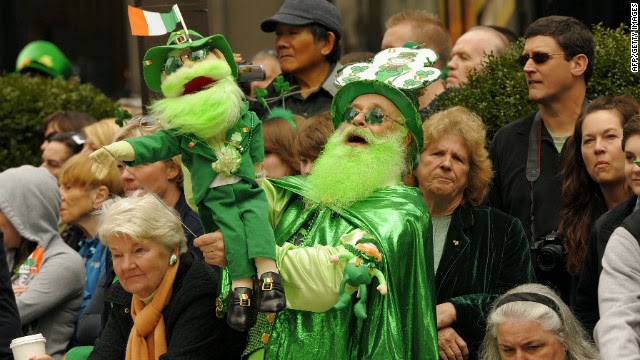
THE St. Patrick's Day Parade

Location:   New York City
Year:   1762


The first St. Patrick's Day celebration in New York City was a 1762 street fair hosted by a Mr. John Marshall, an Irish Protestant, outside his home, Mount Pleasant. Over the next several years, well-to-do persons of Irish descent hosted the annual street fair, held to remember the Old Sod. 


In 1766, the 16th and 47th Regiments of Foot, two British military units comprised entirely of Irishmen, met with the organizers of the street fair and arranged a parade of marchers to the old St. Patrick's Cathedral on the corner of Prince and Mott Streets in lower Manhattan. During the march someone was able to snare a fox.


The Parade became an annual popular event. Early St. Patrick Day Parades in New York were non-sectarian in nature as Irish-born Protestants outnumbered Irish Catholics in the city by a large margin. Historically, there was no animosity between the groups. Leaders of the movement for Irish independence were Protestant as often as not, men like Robert Emmet and Wolfe Tone.  

During the Revolutionary War, General George Washington ordered that his men (many of whom were of Irish and Scots-Irish descent) observe the holiday "in solidarity with the Irish and their own fight for independence." 

 
In 1776, New York City was occupied by the British who did not tolerate public celebrations of any separatist strain. While private celebrations undoubtedly continued, the annual public St. Patrick's Day Parade ceased to be held, beginning again only in 1784.   

Every year, parish churches would compete, attempting to field the most colorful and dramatic marching cadres, complete with bands and banners. This competition grew more intense in the 1840s, when millions of Irish immigrants fleeing the Potato Famine flooded New York. Around 1850, the Irish Fraternal Orders took over the organization of the Parade from the parish churches. 

 
In 1851, the all-Irish 69th Infantry Brigade (N.Y.) began guarding the parade route to forestall violence from club-wielding gangs, fisty drunks and rock-hurling nativists. During the Civil War, the "Fighting 69th" became the lead unit marching in the Parade, and it remains so to this day. 


The competition within the Parade was so fierce (and occasionally violent)  that in 1858, there were actually two competing St. Patrick's Day Parades in New York City. In 1860, the Ancient Order of Hibernians (AOH) took over the organization of the Parade, and calmed the chaos. In 1891, the AOH began using the now-traditional parade route down Fifth Avenue past the new St. Patrick's Cathedral.

New York's St. Patrick's Day Parade is a massive and popular event, drawing tens of thousands of marchers representing hundreds of groups from all over the United States, and millions of spectators. Thanks to the Irish diaspora, it is the largest parade of the most-widely celebrated holiday in the world.  

 
Although it has been afflicted by political issues over time, whether they be Nativism, Civil War, the Irish Troubles, the Choice question, or Gay Rights, regardless of the Issue of The Moment, there's no question that this brilliant  and beloved New York tradition will go on.


Tug Hill

Location:   The North Country
Year:  410 million B.C.E.

Tug Hill (formerly called the Tug Hill Plateau) is a flattened mountain massif across the Black River valley from the Adirondacks. A large ovoid covering some 2,400 square miles, Tug Hill rises to over 2,000 feet. It makes up the western end of New York State's rugged, thinly-populated and remote North Country, and comprises portions of Jefferson, Lewis, Oswego, and Oneida Counties.


Due to its location, Tug Hill has harsh winters. Lying north, inland, and within 50 miles of Lake Ontario, the area is seasonally blasted by lake-effect blizzards combined with an icy continental climate and Canadian cold fronts. Towns on Tug Hill have recorded extended periods of subzero weather and over 300 inches of snow in the winter, the heaviest snowfalls in the eastern United States. A local architectural oddity is second story front doors for use in the snow season.  


The area is heavily forested and subject to conservation, but is a popular hiking and camping area (in the summer) and ski and hunting area (in the winter).  It is an important area for maple syrup production, cheese, and locally-produced handicrafts.